


Core Foundations of Modern Digital Marketing Strategies

In October 2026, the digital world moves faster than ever. Every day, consumers research, interact, and buy online. They are savvy detectives in pajamas, checking delivery options and reviews before making a purchase. This means simply “doing” digital marketing isn’t enough anymore.
The landscape is packed with thousands of tech tools and new AI breakthroughs. Without a clear plan, it’s easy to get lost. A strong digital marketing strategy gives your business direction. It helps you turn online activity into real growth. Businesses with a documented strategy are much more likely to succeed.
This guide will show you how to build a powerful digital marketing strategy from the ground up. We will explore how to set smart goals, choose the right channels, and use AI for better results. We’ll also dive into how to measure success and avoid common mistakes. Our aim is to provide a clear roadmap for your business to thrive in this complex digital era.
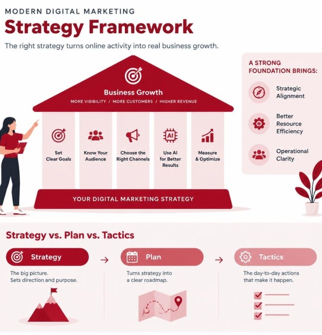
In the dynamic digital landscape of 2026, a robust digital marketing strategy is not merely an option, but a fundamental requirement for sustained business growth. It provides strategic alignment, ensuring all marketing efforts are synchronized with overarching business objectives. This clarity is crucial; businesses with a documented strategy are an impressive 313 percent more likely to achieve their goals. This translates into significant resource efficiency, as efforts are directed towards high-impact activities, and operational clarity, where every team member understands their role in the larger vision. Without this foundational framework, marketing spend can become fragmented, leading to wasted resources and missed opportunities.
Strategy vs. Plan vs. Tactics
To truly understand the core of digital marketing, differentiate between strategy, plan, and tactics. These terms are often used interchangeably, but they represent distinct levels of execution and intent.
- Digital Marketing Strategy: This is the overarching vision. It defines what you want to achieve (your goals), who you want to reach (your target audience), and why you are doing it (your business objectives). It’s about the long-term direction and the competitive moat you aim to build. A strategy provides the strategic intent for all subsequent actions.
- Digital Marketing Plan: This is the detailed roadmap for how you will execute your strategy. It outlines specific campaigns, timelines, budgets, and responsibilities. It translates the strategic intent into actionable steps, detailing the campaign execution across various channels.
- Digital Marketing Tactics: These are the specific, individual actions you take to implement your plan. This could be running a specific Facebook ad, optimizing a blog post for a keyword, or sending an email newsletter. Tactics are about operational agility, the day-to-day tasks that contribute to the larger plan and strategy.
Understanding this hierarchy ensures that every tactical effort contributes to a larger, well-defined strategic goal, fostering channel orchestration rather than disjointed activities.
Feature Digital Marketing Strategy Digital Marketing Plan Digital Marketing Tactics Scope Broad, long-term vision (1-3+ years) Detailed, medium-term execution (3-12 months) Specific, short-term actions (daily/weekly) Timeframe Long-term Medium-term Short-term Core Objectives Defines what to achieve and why (overall business goals) Outlines how to achieve strategy (campaigns, budgets) Specifies individual actions to implement the plan Aligning Business Goals with Strategic KPIs
The effectiveness of any digital marketing strategy hinges on its direct alignment with broader business goals. This means every marketing objective must ultimately contribute to the company’s bottom line. We use the SMART framework—Specific, Measurable, Achievable, Relevant, and Time-bound—to ensure clarity and trackability for our goals.
For instance, a business goal of “increase revenue by 20% in the next year” can translate into digital marketing objectives like:
- “Increase qualified lead generation by 30% through organic search within 9 months.”
- “Reduce customer acquisition cost (CAC) by 15% through optimized paid social campaigns in 6 months.”
- “Improve customer lifetime value (LTV) by 10% through personalized email nurture sequences over 12 months.”
These objectives are then monitored using key performance indicators (KPIs). We distinguish between leading indicators (e.g., website traffic, engagement rates, click-through rates) which predict future performance, and lagging metrics (e.g., sales, revenue, profit margins) which reflect past outcomes. Connecting these ensures that marketing activities are not just busy work, but directly contribute to measurable business success. For businesses seeking expert guidance in navigating these complexities, partnering with a reputable digital marketing agency can provide the strategic clarity needed to define and achieve these objectives.
Essential Steps to Build an Omnichannel Strategy
Building an effective omnichannel digital marketing strategy in 2026 requires a methodical approach, starting with a deep understanding of the market and your place within it. This involves thorough market analysis to identify trends and opportunities, competitive benchmarking to understand what your rivals are doing well (and where they fall short), and precise customer segmentation to ensure your messages resonate with the right people. An omnichannel strategy isn’t just about being on multiple channels; it’s about providing a seamless, integrated customer experience across every touchpoint.

Audience Segmentation and Journey Mapping
At the heart of any successful digital marketing strategy is a profound understanding of your audience. We go beyond basic demographics to create detailed buyer personas, which are semi-fictional representations of your ideal customers based on real data. This involves gathering behavioral data from website analytics, social media insights, and CRM systems. Critically, we also prioritize zero-party data – information customers willingly share about their preferences and intentions – to build more accurate profiles.
Qualitative interviews with existing customers and sales teams provide invaluable insights into their pain points, motivations, and language. This rich data then informs intent mapping, allowing us to understand what customers are trying to achieve at different stages of their journey. By mapping these micro-moments – the points where consumers turn to a device to act on a need – we can ensure our content and messaging are perfectly timed and relevant, guiding them smoothly through their customer journey.
Designing Content for High-Performance Digital Marketing Strategies
Content is the fuel for your digital marketing engine, but its effectiveness depends entirely on its strategic design and alignment with the customer journey. We focus on creating content that serves specific purposes at each stage:
- Top-of-Funnel (Awareness): Here, the goal is to attract a broad audience by addressing general pain points or interests. Content utility is key, offering educational assets like blog posts, infographics, and short videos that provide value without directly selling.
- Middle-of-Funnel (Consideration): As prospects move further, they are evaluating solutions. Content here should help them understand how your offering addresses their specific needs. This includes case studies, comparison guides, webinars, and expert interviews.
- Decision (Bottom-of-Funnel): At this stage, customers are ready to make a purchase. Content should enable their decision with product demos, free trials, testimonials, and detailed pricing information.
- Post-Purchase (Retention): The journey doesn’t end at conversion. Retention content focuses on onboarding, support, loyalty programs, and exclusive content to foster long-term relationships and brand advocacy.
By carefully designing content for each stage, we ensure a cohesive and high-performance digital marketing strategy that nurtures leads from initial interest to loyal customer.
Channel Selection and Budget Allocation Frameworks
Choosing the right digital marketing channels is less about being everywhere and more about being effective where your target audience spends their time. Our approach involves a strategic channel synergy, identifying the 2-3 primary platforms that offer the best reach and engagement for your specific audience. Once channels are selected, a robust budget allocation framework is essential to maximize ROI. We often employ a 70-20-10 split:
- 70%: Allocated to proven channels and tactics that consistently deliver results. This ensures stable performance and leverages existing successes.
- 20%: Dedicated to optimizing and expanding existing successful channels, perhaps by testing new ad formats or content types within those platforms.
- 10%: Reserved for experimental testing of new, emerging channels or innovative tactics. This allows for agility and discovery of future high-performing avenues without risking the bulk of the budget.
This framework allows for continuous improvement and innovation while maintaining a strong core. Resource allocation should always be data-driven, with performance dictating future investments. When the goal is rapid, measurable customer acquisition, collaborating with a specialized acquisition marketing agency can be particularly effective in optimizing paid channels for maximum ROI.
We categorize digital marketing channels into three main types:
Channel Type Reach Control Long-Term ROI Owned Media Limited by audience you build High (website, blog, email list) High (builds assets, sustainable) Earned Media Potentially vast (viral, PR) Low (dependent on others) High (credible, organic trust) Paid Media Scalable (budget-dependent) High (targeting, messaging) Variable (depends on optimization, can be high) Next-Generation Channels and Technical Optimization
The digital marketing landscape of 2026 is defined by constant evolution, demanding that businesses not only master traditional channels but also embrace next-generation technologies and optimization techniques. Our focus is on achieving superior search visibility, executing multi-channel marketing with seamless integration, and leveraging advanced technical strategies to stay ahead. This means understanding how channels interact and how emerging technologies like AI are reshaping user interactions and expectations.
Foundational SEO and Generative Engine Optimization
SEO remains a cornerstone of digital marketing, but its nature has transformed significantly. In 2026, we’re not just optimizing for keywords; we’re optimizing for intent, context, and the rise of Generative Engine Optimization (GEO). This means focusing on:
- E-E-A-T Signals: Google’s emphasis on Experience, Expertise, Authoritativeness, and Trustworthiness is more critical than ever. Content must be created by credible sources and demonstrate deep knowledge.
- Structured Data: Implementing schema markup helps search engines understand the context of your content, making it more likely to appear in rich snippets, knowledge panels, and AI-generated answers.
- Search Intent: Understanding the underlying “why” behind a search query is paramount. Content should directly answer user questions, not just contain keywords.
- Voice Optimization and Conversational Queries: With the proliferation of smart speakers and voice assistants, optimizing for natural language and conversational queries is essential. This involves using long-tail keywords and providing concise, direct answers.
- AI-Powered Search: As AI Overviews become more prevalent, search engines increasingly answer queries directly within the search results, reducing click-throughs. Our strategy adapts by focusing on providing comprehensive, authoritative answers that AI can draw from, ensuring brand visibility even in zero-click scenarios.
Integrating AI Tools into Digital Marketing Strategies
Artificial intelligence is no longer a futuristic concept; it’s an integral part of modern digital marketing. We leverage AI tools to enhance efficiency, personalization, and predictive capabilities:
- Automated Workflows: AI automates repetitive tasks like data analysis, report generation, and even initial content drafting, freeing up human marketers for more strategic work.
- Predictive Retention and Churn Modeling: AI analyzes customer behavior to identify patterns that indicate potential churn. This allows us to proactively deploy targeted campaigns or offers to retain at-risk customers.
- Hyper-Personalization: AI enables us to deliver highly personalized content, product recommendations, and offers at scale, based on individual user preferences and real-time behavior.
- Dynamic Segmentation: AI can dynamically segment audiences based on evolving behaviors, allowing for more precise targeting than static personas alone.
- Human Oversight: While AI offers immense power, human oversight remains crucial. We use AI as a strategic co-pilot, guiding its output and ensuring ethical considerations and brand voice are maintained. AI accelerates research, content drafting, and personalization, but the strategic judgment and creative spark still come from human marketers.
Owned Media and Customer Retention Systems
In an era of fluctuating algorithms and rising ad costs, owned media assets are more valuable than ever. These are channels you fully control, providing direct access to your audience and fostering long-term customer relationships.
- Email Automation: Building and nurturing an email list is a high-ROI activity. We implement sophisticated email automation sequences for welcome series, abandoned cart reminders, nurture flows, and loyalty programs.
- Database Governance: A clean, segmented, and well-managed customer database is critical. This ensures personalization is effective and compliance with privacy regulations is maintained.
- Community Building: Creating dedicated online communities (e.g., private forums, Slack channels, Facebook groups) fosters brand loyalty, provides valuable feedback, and transforms customers into advocates.
- SMS Marketing: For direct and immediate communication, SMS marketing offers high open rates. It’s particularly effective for promotions, order updates, and time-sensitive offers.
- Fulfillment Alignment: A unique but increasingly critical aspect of owned media is ensuring that your marketing promises are backed by reliable logistics and inventory management. If your marketing campaigns drive sales, but your fulfillment falters (e.g., slow shipping, stockouts), it damages brand reputation. Effective inventory management ensures product availability, prevents stockouts or overstock, and aligns fulfillment with marketing campaigns. This means working with reliable third-party logistics (3PL) partners and having robust internal processes.
- Brand Advocacy: By nurturing relationships and providing exceptional experiences, owned media channels cultivate brand advocates who organically promote your business.
Measurement, Attribution, and Performance Optimization
In 2026, simply tracking clicks and impressions is insufficient. Our approach to digital marketing centers on rigorous measurement, accurate attribution, and continuous performance optimization. This means moving beyond vanity metrics to focus on real business intelligence, connecting every marketing activity to revenue generation.
Multi-Touch Attribution and Unified Data Pipelines
Understanding which marketing touchpoints contribute to a conversion is complex in an omnichannel world. We employ multi-touch attribution models to allocate credit more accurately across the customer journey, moving beyond simplistic last-click models.
Attribution Model Data Requirements Attribution Accuracy Operational Complexity Last-Click Basic (platform defaults) Low (overvalues final touch) Low (easy to implement) First-Click Basic Low (overvalues initial touch) Low Linear Moderate (all touches tracked) Medium (equal credit, ignores weight) Medium Time Decay Moderate Medium-High (more credit to recent touches) Medium Position-Based Moderate Medium-High (first/last get more, middle less) Medium Data-Driven (AI) High (machine learning, large datasets) High (learns optimal credit distribution) High (requires advanced tools/expertise) Crucially, this requires robust data governance and unified data pipelines. We centralize data from all platforms—ad platforms, web analytics, CRMs, marketing automation, email tools, and even offline sources—into a single data warehouse. This automates the extraction, transformation, and loading (ETL) process, eliminating data silos and providing a real-time, holistic view of performance. This unified approach enables precise conversion tracking and even the integration of offline conversions, providing a complete picture of pipeline velocity and true ROI.
Continuous Testing and Conversion Rate Optimization
The digital landscape is constantly shifting, so our strategies must be adaptable. We embed a culture of continuous testing and Conversion Rate Optimization (CRO) into every aspect of our digital marketing.
- A/B Testing: We systematically test different elements – headlines, ad copy, creative visuals, calls-to-action, landing page layouts – to identify what resonates best with our audience. This single-variable testing ensures we can isolate the impact of each change.
- Landing Page Optimization: Dedicated landing pages are critical for converting traffic. We analyze user behavior on these pages, identifying areas of friction and optimizing for clarity, relevance, and persuasive design.
- Friction Reduction: Every step in the customer journey should be as smooth as possible. We continuously look for ways to reduce friction, whether it’s simplifying checkout processes, improving website navigation, or streamlining form submissions.
- Feedback Loops: Establishing clear feedback loops between marketing, sales, and customer service teams provides invaluable qualitative data, helping us understand customer pain points and inform optimization efforts.
- Iterative Refinement: CRO is not a one-time project but an ongoing process of iterative refinement. We analyze test results, implement winning variations, and then test again, always striving for marginal gains that accumulate into significant improvements over time.
Common Strategic Pitfalls to Avoid
Even with the best intentions, businesses can fall into common traps when developing and executing digital marketing strategies. We’ve identified several critical pitfalls to avoid:
- Tool Sprawl without Integration: Accumulating numerous marketing tools without ensuring they integrate effectively creates data silos and increases complexity, rather than efficiency. Marketers now have over 7,000 options for marketing technology, making this a significant risk.
- Neglecting Data Governance: Without a clear strategy for collecting, storing, and analyzing data, insights remain elusive, and decisions are based on intuition rather than evidence.
- Premature Scaling: Attempting to scale campaigns or channels before proving their effectiveness on a smaller scale often leads to significant budget waste.
- Isolated Campaigns: Running individual campaigns without a cohesive strategic framework or understanding how they contribute to the larger customer journey leads to disjointed experiences and inefficient spending.
- Ignoring Customer Retention: Focusing solely on customer acquisition while neglecting the existing customer base is a costly mistake. Retaining customers is often more cost-effective than acquiring new ones.
- Chasing Vanity Metrics: Prioritizing metrics like social media likes or website page views over revenue-generating KPIs (leads, conversions, ROI) can obscure true business impact.
- Outsourcing All Knowledge: While agencies are valuable partners, outsourcing all digital marketing knowledge without maintaining internal expertise can lead to dependency and a lack of strategic control.
- Underestimating Content Creation: Social media, in particular, is content and resource-intensive. Under-allocating budget for high-quality visual content can severely limit campaign effectiveness.
Frequently Asked Questions About Digital Marketing Strategies
How often should a business update its digital marketing strategy?
The digital landscape is in constant flux, driven by technological advancements, algorithm changes, and evolving consumer behaviors. Therefore, a digital marketing strategy should be a living document, not a static one. We recommend a multi-tiered review approach:
- Monthly Review Cadences: Conduct monthly reviews of key performance indicators (KPIs) and campaign performance. This allows for tactical adjustments and optimization of ongoing efforts.
- Quarterly Adjustments: Perform a strategic review every quarter. This involves assessing whether current strategies are still aligned with business goals, analyzing market shifts, and making necessary adjustments to plans and resource allocation.
- Annual Refreshes: Undertake a comprehensive strategy refresh annually. This is the time to re-evaluate the entire market, competitive landscape, audience personas, and emerging technologies, setting new long-term objectives for the upcoming year.
- Ad-Hoc Updates: Be prepared for ad-hoc updates in response to significant market shifts, such as major algorithm changes, new platform features, or unforeseen global events.
What is the most effective way to allocate marketing budget across channels?
Effective budget allocation is crucial for maximizing ROI. We advocate for a balanced investment approach that considers channel maturity, performance data, and the potential for experimentation:
- Performance-Based Allocation: Allocate the largest portion (e.g., 70%) of your budget to channels and tactics that have consistently proven to deliver the highest ROI and contribute most directly to your business goals.
- Optimization & Expansion: Dedicate a segment (e.g., 20%) to optimizing and expanding successful channels. This might involve A/B testing new ad creatives, exploring new audience segments, or increasing spend on high-performing campaigns.
- Experimental Testing: Reserve a smaller portion (e.g., 10%) for testing new channels, emerging technologies (like AI tools), or innovative tactics. This allows you to stay agile and discover future growth opportunities without jeopardizing core performance.
- Channel Maturity: Consider the maturity of each channel for your business. New channels may require more initial investment for testing and learning, while established ones might benefit from fine-tuning.
- Audience Presence: Always prioritize channels where your target audience is most active and receptive to your messaging.
How do zero-click searches and AI engines impact marketing execution?
The rise of AI-powered search (like Google’s AI Overviews) and the increasing prevalence of zero-click searches (where users find answers directly on the search results page without clicking through to a website) are fundamentally reshaping marketing execution in 2026.
- Answer Engines, Not Just Search Engines: Search engines are evolving into “answer engines.” This means our content strategy must focus on providing concise, authoritative, and complete answers to common user queries directly within our content.
- Direct Visibility and Brand Authority: While click-throughs may decrease for some informational queries, appearing in AI-generated summaries or featured snippets still offers significant direct visibility and reinforces brand authority. Our goal is to be the source from which AI draws its answers.
- Content Restructuring: Content needs to be structured for AI consumption, using clear headings, bullet points, and schema markup. Generative Engine Optimization (GEO) requires content that is easily digestible and provides self-contained answers at the paragraph level.
- Focus on Deeper Engagement: For queries that still require clicks, the content must offer deeper value, unique insights, or interactive experiences that AI summaries cannot replicate. This pushes us to create more comprehensive guides, tools, and community-driven content.
- Shift to Conversational SEO: Optimizing for natural language and conversational queries becomes even more important as AI assistants become more sophisticated.
Conclusion
In October 2026, navigating the digital marketing landscape demands more than just a presence; it requires a sophisticated, data-driven strategy. We’ve explored how a clear understanding of strategy versus tactics, coupled with SMART goal setting and robust audience insights, forms the bedrock of success. From designing high-performance content for every stage of the customer journey to strategically allocating budgets across owned, earned, and paid media, every element must work in concert.
The integration of AI tools for hyper-personalization and predictive analytics, alongside a renewed focus on foundational SEO and Generative Engine Optimization, are no longer optional but essential. Moreover, the emphasis on owned media and meticulous customer retention systems, supported by reliable logistics, ensures long-term agility and sustainable growth. By embracing multi-touch attribution, unified data pipelines, and a culture of continuous optimization, businesses can move beyond fragmented efforts to achieve holistic execution and measurable results in this complex digital era.