


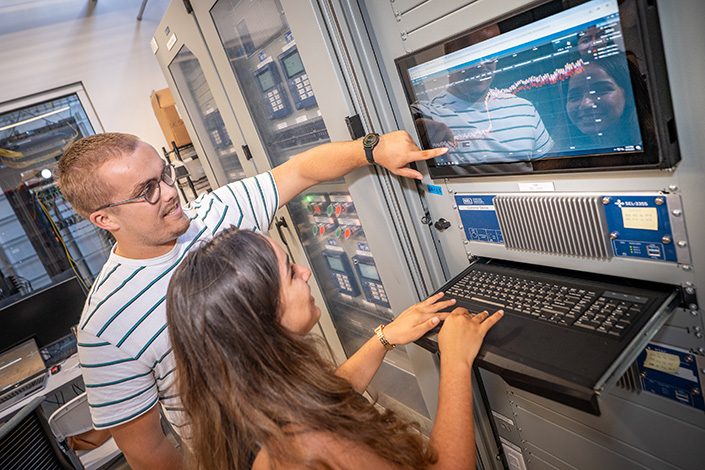
Walk into most engineering college automobile labs today and you’ll find the same scene: a sectioned IC engine on a stand, a carburettor cutaway, maybe a dynamometer that last saw a calibration sticker sometime around 2018. The industry outside those doors, though, has moved on entirely.
India crossed 1.5 million EV registrations in FY2023–24, per VAHAN data. OEMs, Tier-1 suppliers, and charging infrastructure firms are hiring hard for roles that didn’t exist when most of these labs were built. Yet students coming out of most programmes have never touched a BMS, traced a CAN frame, or put an onboard charger under real load. Something’s off — and it’s getting harder to paper over.
Get the Brief Right Before Anything Else
Most institutions get this wrong before spending a single rupee. They treat it like a standard lab procurement — budget approved, vendors shortlisted, equipment arrives, and six months later nobody’s sure what experiments it was supposed to run.
A proper ev lab setup works from the opposite direction. What is the institution actually trying to produce? If the answer is undergraduates who can walk into an EV company and be useful quickly, you want modular trainers built around structured experiments — drivetrain characterisation, BMS configuration, EVSE simulation. If the answer is postgraduate research into battery thermal behaviour, that’s a different procurement: thermal chambers, high-precision data loggers, real cells rather than training models.
Many universities need both — which is fine. The problem is conflating them into one brief. A teaching lab and a research lab have different footprints, different safety classifications, and very different maintenance demands. Sorting this before writing a PO is the difference between a lab that runs well and one that sits half-used.
What Actually Goes Inside
Better to think in layers than a flat equipment list.
More Read

The drivetrain is foundational — motors, inverters, regenerative braking. Students need to physically load a BLDC or PMSM motor, sweep torque curves, and watch efficiency fall under thermal stress. Trainers that replicate this on a screen rather than in hardware miss the point.
Battery management is where textbooks fall shortest. A BMS learn-and-build module should let students wire cell groups, configure balancing thresholds, and see what happens when a cell drifts out of spec. SOC estimation, protection relay behaviour — you don’t learn these from a simulation. You learn them by getting it wrong on a bench.
Power electronics needs dedicated space: DC-DC converters, bidirectional onboard chargers, inverter topologies — all requiring proper isolated supplies and real hardware. Vehicle communication protocols (CAN bus, LIN, OBD-II) tend to get underweighted in lab planning, which is a mistake hiring managers notice. And safety infrastructure — PPE, insulation testers, high-voltage training — belongs in session one, not tacked on at the end.
Infrastructure: What Nobody Budgets For
The equipment list is the visible cost. Everything underneath it is where the surprises are.
A realistic ev lab setup needs 150 to 300 square metres of floor space. What catches institutions off guard is the power supply — 415V three-phase is required for serious charging simulation. If the existing panel can’t support that load, you’re into civil works before a single piece of equipment ships. Ventilation is similarly underestimated: lithium-ion cells off-gas during stress testing, and dedicated fume extraction is a safety requirement, not an upgrade. Earthing and bonding must follow IS 3043, the BIS specification for electrical installations.
Sort the cable trunking layout before locking in bench positions. High-voltage power runs and low-voltage signal cables interact badly when mixed. Retrofitting it later is a headache nobody needs.
Curriculum and Procurement
A well-structured ev lab setup runs 30 to 40 experiments tiered across three levels — foundational, intermediate, and advanced. Every experiment needs a written procedure, measurement parameters, and a results format. That documentation isn’t bureaucratic overhead; it’s what makes the lab legible to NBA and NAAC reviewers who want explicit mappings between lab activities and programme outcomes.
On procurement: budget-to-commissioning timelines of 12 to 18 months are normal. Find vendors who can deliver the whole engagement — equipment, installation, commissioning, and faculty training — rather than piecing it together from multiple suppliers. Multi-vendor integrations sound fine on paper; in practice something always falls through the gap. Ask for references at comparable institutions, and visit one if you can. What a lab looks like in a vendor presentation and what it looks like eighteen months into use are sometimes very different.
Faculty and the Investment Case
Labs fail quietly when the people meant to run them aren’t ready. Insist on three to five days of structured on-site faculty training as part of the installation contract, not a verbal add-on. Internally, identify two or three faculty champions and give them time with the equipment before student batches start. Institutions that do this stop depending on vendor support within a year. Institutions that don’t are still making those same calls three years later.
The FAME India Phase II scheme is actively building sector demand, and industry appetite for EV-trained engineers already outpaces supply. Institutions that move in the next two years will draw the students, faculty, and industry partnerships that follow those signals. The ones that wait will spend the back half of the decade explaining to placement committees why their graduates need months of retraining before they’re useful on an EV project.